Showing posts with label Church Fathers. Show all posts

6/16/16

Backwards is Still Backwards

The Holy Scriptures, throughout history, have been the most interpreted and read book by humanity. Of course, this also means that the Holy Scriptures have also been the most misinterpreted book in human history as well. In fact, the Scriptures themselves have a couple things to say about this.

2 Peter 2:1 (ESV): But false prophets also arose among the people, just as there will be false teachers among you, who will secretly bring in destructive heresies, even denying the Master who bought them, bringing upon themselves swift destruction.

2 Peter 1:20-21 (ESV): knowing this first of all, that no prophecy of Scripture comes from someone's own interpretation. For no prophecy was ever produced by the will of man, but men spoke from God as they were carried along by the Holy Spirit.


So, with this being said, there have been some different ideas that have been proposed over the years. Rome answers plainly that they, and only they, have the right to interpret the Holy Scriptures. Official interpretations laid down by the Magisterium are binding. On the other hand, many modern day evangelicals have proposed that everyone has the right to interpret Scripture for themselves. But this is clearly contrary to 2 Peter 1:20-21.

There is a better way. It's called sola scriptura. Far from being the modern day evangelical approach, sola scriptura simply confesses that Scripture alone is the only source for infallible doctrine. Sola scriptura takes into account church history and the writings and interpretations of church fathers and scholars.

All of this being said, this is not the main point of this post, but it does back up what the post is really about: The completely backwards manner in which much of evangelical Christianity interprets the Holy Scriptures. It is known as dispensationalism.

Dispensationalists hold to a literal interpretation of the Bible as the best hermeneutic. The literal interpretation gives each word the meaning it would commonly have in everyday usage. Allowances are made for symbols, figures of speech, and types, of course. It is understood that even symbols and figurative sayings have literal meanings behind them. So, for example, when the Bible speaks of “a thousand years” in Revelation 20, dispensationalists interpret it as a literal period of 1,000 years (the dispensation of the Kingdom), since there is no compelling reason to interpret it otherwise. (Source: http://www.gotquestions.org/dispensationalism.html)

Many dispensationalists like to turn up their noses in a sort of spiritual pride that they are the only ones who interpret Scripture literally and everyone else "spiritualizes away" stuff. As you can see, dispensationalism prides itself on being a literal interpretation of the Holy Scriptures.

But. It's. Not.

What dispensationalism fails to mention is that the entire system interprets many didactic teachings -which are literal- in a figurative or symbolic manner, all the while going directly against the historic teachings and doctrines of the Christian Church. Need some examples? Happy to oblige.

In dispensationalism, the Sacraments of Holy Baptism and Holy Communion are completely jettisoned. Whereas the Holy Scriptures plainly say that baptism buries us with Christ and raises us in faith (cf. Rom 6:34, Col 2:12) and that baptism now saves us (1 Pet 3:21), dispensationalism asserts that baptism is the "...means by which a person makes a public profession of faith and discipleship. In the waters of baptism, a person says, wordlessly, “I confess faith in Christ; Jesus has cleansed my soul from sin, and I now have a new life of sanctification." (Source: http://www.gotquestions.org/Christian-baptism.html)

In other words, baptism is done only after a person is already saved and thus is an act of our obedience to God and not an act of God given to us. It is therefore man's work and not God's work in this theology.

The Lord's Supper is another glaring example. The Church has always taught, based on Scripture, that Christ is truly bodily present in bread and wine at the Lord's Supper. Dispensationalism says otherwise.

John MacArthur, himself a dispensationalist, says, "In saying the bread is His body, Jesus obviously was not speaking literally. A similarly foolish misunderstanding already caused the Pharisees to ridicule Him and many superficial disciples to desert Him (John 6:48-66). It is the same misunderstanding reflected in the Roman Catholic doctrine of transubstantiation. That literalistic notion is an absurd misinterpretation of Scripture." (Source: http://www.gty.org/blog/B130328/instituting-the-lords-supper)

What MacArthur fails to realize here is that his little barb aimed at Rome is also aimed directly at what the entire Church has believed for 2000 years. The true bodily presence of Christ in the Eucharist is one of the most easily proved doctrines that the early church held. Don't believe me? Read some of the early church fathers.

As an aside, these ideas are at the forefront of what is known as Restorationism. Restorationism is the belief that the Christian Church committed gross apostasy very early in church history and the church was all but gone for nearly 1800 years. It was then restored to its original teachings and glory in the 1800s, which resulted in separatist sects such as the Plymouth Brethren - who are dispensational to the core. Who woulda thunk it?

Lutheran Satire pretty much nails it here:


The flip side of the problem with dispensationalism is that not only does the system reject literal interpretation of numerous didactic teachings, but they also affirm literal interpretation of symbolic books of Scripture - namely, Daniel and Revelation. Scripture uses numbers quite often as symbolic language. Dispensationalism says otherwise, insisting on a literal 1000 year reign of Christ on Earth, presiding over a mixture of glorified saints and people still in the flesh. Weird.

Dispensationalism is also the source of the zany and wacky pre-tribulation rapture nonsense that most evangelical Christians are taught now days, especially in the United States. If you want to know more about pre-trib, read the Left Behind series or anything by Hal Lindsey.

Likewise, dispensationalism has no support from any church fathers or scholars for well over 1000 years (enter Restorationism, of course) or from the Holy Scriptures themselves. But at the end of the day, backwards will be backwards no matter how you slice it.

If you read didactic teachings symbolically, and symbolic books literally, you might be a dispensationalist. And to be clear, you do not believe Christian Orthodoxy in these areas. What you believe is a very new system of thought that flatly rejects what Christianity has always taught and believed in many areas.

And. That. Is. Not. Good.

+Pax+

10/30/15

Make It Say What You Want!

Let's face it. A person can make the Bible say and mean what they want it to. It's really not that difficult. Unfortunately, the most common idea in 20th and 21st century American theology is that every individual Christian should get to interpret the Bible for themselves. Not only that, but also that this is the proper manner in which to read and interpret God's Word. We hear all too often of the idea that one person's interpretation is just as good as the next person's. We've even extrapolated this idea further and people have downplayed the importance of attending church. Many people refuse to attend church at all, instead favoring a do it yourself sort of approach. I don't know what else to call this other than completely wrong. Christians are not islands unto themselves, free to make Scripture say whatever they would like it to - all the while claiming the Holy Spirit's guidance on their own little divine revelations into the proper meanings of Holy Writ, not caring one wit that their ideas and interpretations are nowhere near what Christianity has always taught and believed.

This is precisely why the Christian Church has creeds and confessions of faith. Not to mention, this is the reason the Church has had numerous ecumenical councils in the past.

The three great ecumenical creeds are a great place to start regarding core fundamental Christian teaching. If a person or church denies anything in these three creeds, a red flag should be raised immediately. If you can't affirm these three great creeds, call yourself something other than Christian. They are in essence saying that they, based on their own personal interpretation of Scripture, know certain things and doctrines in Scripture more accurately than the great fathers of the church who convened and agreed upon these great creeds. Imagine if that person were there, present at those councils. Perhaps the great fathers of the church would sway them, who knows.

One common objection that people bring up here is that they only need Scripture and the Holy Spirit, not the creeds. But this objection completely misses the point. The creeds are summaries of core fundamental doctrines that Scripture teaches. True, they are not Scripture itself, but they tell us what the Scriptures actually teach.

The idea of me, my Bible, and the Holy Spirit in a corner actually denies the Bible and the Holy Spirit. It ends up being all me. Both the Bible and the Holy Spirit point a person to Christ, and Christ is to be found in His Word and His Sacraments. This the Bible explicitly states. Moreover, this idea of Christianity that is so popular is actually a rejection of Christianity as well as a rejection of the gifts that Christ gives us. In other words, it's not Christianity at all. It is nothing more than a self-serving individualism that happens to like Jesus - just not the historic one. So it really doesn't like Jesus either on some level.

What Christian rejects the three ecumenical creeds as false? Well, none should. The creeds are core doctrine. If you reject the Apostle's Creed, you reject the most basic teachings of Christianity. If you reject the Nicene Creed, the same thing applies. If you reject the Athanasian Creed, you reject the Trinity and that puts you outside of Christianity and salvation altogether.

But we know better because we've got the Holy Spirit, right? Well, don't you think the Holy Spirit also guided these great fathers of the faith who formulated the creeds? Or do you think they were just hearing from themselves, or worse, evil spirits?

If you are unfamiliar with the three great ecumenical creeds, you can find them here: BOC: Creeds

To summarize here, there is simply no room for interpretation on many core doctrinal teachings of the Christian Church. You don't need to convene your own ecumenical council of me, myself, and I in the corner of your basement, waiting for "God" to talk to you personally and tell you how it really is. In fact, that path is decidedly antichrist. It always leads a person away from core teachings, not towards them.

Just look at the fruits of this idea. Denial of original sin. Denial of the virgin birth. Rejection of the Trinity, usually aligning with some ancient heresy or another. Dualism that separates the natural from the spiritual resulting in a rejection of the Real Presence and of Baptismal Regeneration and ultimately the Incarnation of Christ and the Gospel itself. Not to mention when the Bible gets interpreted by people who flat out admit they are not Christians. Muslims and Atheists do this all the time. We could go on and on.

This idea needs to be outed for what it is: Antichrist. Time has shown us that this leads to nothing but bad theology and usually a rejection of Christianity itself.

+Pax+

10/29/15

Tertullian the Montanist as your supposed Trail of Blood Baptist

There's some documented Trail of Blood Baptist views of Tertullian.

In On Baptism, Chapter 1, he wrote:

"Happy is our sacrament of water, in that, by washing away the sins of our early blindness, we are set free and admitted into eternal life!"

In Against Marcion, Book I, Chapter 28, he wrote:

"And what will happen to him after he is cast away? He will, they say, be thrown into the Creator's fire. Then has no remedial provision been made (by their god) for the purpose of banishing those that sin against him, without resorting to the cruel measure of delivering them over to the Creator? And what will the Creator then do? I suppose He will prepare for them a hell doubly charged with brimstone, as for blasphemers against Himself; except indeed their god in his zeal, as perhaps might happen, should show clemency to his rival's revolted subjects. Oh, what a god is this! everywhere perverse; nowhere rational; in all cases vain; and therefore a nonentity! — in whose state, and condition, and nature, and every appointment, I see no coherence and consistency; no, not even in the very sacrament of his faith! For what end does baptism serve, according to him? If the remission of sins, how will he make it evident that he remits sins, when he affords no evidence that he retains them? Because he would retain them, if he performed the functions of a judge. If deliverance from death, how could he deliver from death, who has not delivered to death? For he must have delivered the sinner to death, if he had from the beginning condemned sin. If the regeneration of man, how can he regenerate, who has never generated? For the repetition of an act is impossible to him, by whom nothing any time has been ever done. If the bestowal of the Holy Ghost, how will he bestow the Spirit, who did not at first impart the life? For the life is in a sense the supplement of the Spirit. He therefore seals man, who had never been unsealed in respect of him; washes man, who had never been defiled so far as he was concerned; and into this sacrament of salvation wholly plunges that flesh which is beyond the pale of salvation! No farmer will irrigate ground that will yield him no fruit in return, except he be as stupid as Marcion's god. Why then impose sanctity upon our most infirm and most unworthy flesh, either as a burden or as a glory? What shall I say, too, of the uselessness of a discipline which sanctifies what is already sanctified? Why burden the infirm, or glorify the unworthy? Why not remunerate with salvation what it burdens or else glorifies? Why keep back from a work its due reward, by not recompensing the flesh with salvation? Why even permit the honour of sanctity in it to die?"

And he wrote in On the Resurrection of the Flesh, he said,

"Now such remarks have I wished to advance in defence of the flesh, from a general view of the condition of our human nature. Let us now consider its special relation to Christianity, and see how vast a privilege before God has been conferred on this poor and worthless substance. It would suffice to say, indeed, that there is not a soul that can at all procure salvation, except it believe while it is in the flesh, so true is it that the flesh is the very condition on which salvation hinges. And since the soul is, in consequence of its salvation, chosen to the service of God, it is the flesh which actually renders it capable of such service. The flesh, indeed, is washed, in order that the soul may be cleansed; the flesh is anointed, that the soul may be consecrated; the flesh is signed (with the cross), that the soul too may be fortified; the flesh is shadowed with the imposition of hands, that the soul also maybe illuminated by the Spirit; the flesh feeds on the body and blood of Christ, that the soul likewise may fatten on its God."

So as we can see here, he affirmed the Trail of Blood Baptist views of baptismal regeneration and Eucharistic presence.

Oh wait, both are complete opposite of what Baptists believe!

Folks need to stop parroting that woefully inaccurate book Trail of Blood  with claims like Tertullian and the Montanists (who he identified himself with) held to their views when the opposite is true.

Like, seriously.

Here we stand.

11/15/14

Baptism is for Oranges

The Council of Orange (529 AD) is a famous early church ecumenical council. There are a few major points we can draw from this council.

First, the council was utterly against all forms of Pelagianism. In other words, the dispute between St. Augustine of Hippo and the (probably) British monk Pelagius was discussed at this council. The council sided with St. Augustine on this issue; precisely because Holy Scripture sides with St. Augustine's stances in this area.

The other major thing we can take away from these canons is that Orange taught divine monergism and linked it directly to Holy Baptism.

CANON 1. If anyone denies that it is the whole man, that is, both body and soul, that was "changed for the worse" through the offense of Adam's sin, but believes that the freedom of the soul remains unimpaired and that only the body is subject to corruption, he is deceived by the error of Pelagius and contradicts the scripture which says, "The soul that sins shall die" (Ezek. 18:20); and, "Do you not know that if you yield yourselves to anyone as obedient slaves, you are the slaves of the one whom you obey?" (Rom. 6:16); and, "For whatever overcomes a man, to that he is enslaved" (2 Pet. 2:19).

CANON 2. If anyone asserts that Adam's sin affected him alone and not his descendants also, or at least if he declares that it is only the death of the body which is the punishment for sin, and not also that sin, which is the death of the soul, passed through one man to the whole human race, he does injustice to God and contradicts the Apostle, who says, "Therefore as sin came into the world through one man and death through sin, and so death spread to all men because all men sinned" (Rom. 5:12).

CANON 7. If anyone affirms that we can form any right opinion or make any right choice which relates to the salvation of eternal life, as is expedient for us, or that we can be saved, that is, assent to the preaching of the gospel through our natural powers without the illumination and inspiration of the Holy Spirit, who makes all men gladly assent to and believe in the truth, he is led astray by a heretical spirit, and does not understand the voice of God who says in the Gospel, "For apart from me you can do nothing" (John 15:5), and the word of the Apostle, "Not that we are competent of ourselves to claim anything as coming from us; our competence is from God" (2 Cor. 3:5).

Second, the council affirms baptismal regeneration and rejects double predestination.

CANON 5. If anyone says that not only the increase of faith but also its beginning and the very desire for faith, by which we believe in Him who justifies the ungodly and comes to the regeneration of holy baptism -- if anyone says that this belongs to us by nature and not by a gift of grace, that is, by the inspiration of the Holy Spirit amending our will and turning it from unbelief to faith and from godlessness to godliness, it is proof that he is opposed to the teaching of the Apostles, for blessed Paul says, "And I am sure that he who began a good work in you will bring it to completion at the day of Jesus Christ" (Phil. 1:6). And again, "For by grace you have been saved through faith; and this is not your own doing, it is the gift of God" (Eph. 2:8). For those who state that the faith by which we believe in God is natural make all who are separated from the Church of Christ by definition in some measure believers.

CANON 8. If anyone maintains that some are able to come to the grace of baptism by mercy but others through free will, which has manifestly been corrupted in all those who have been born after the transgression of the first man, it is proof that he has no place in the true faith. For he denies that the free will of all men has been weakened through the sin of the first man, or at least holds that it has been affected in such a way that they have still the ability to seek the mystery of eternal salvation by themselves without the revelation of God. The Lord himself shows how contradictory this is by declaring that no one is able to come to him "unless the Father who sent me draws him" (John 6:44), as he also says to Peter, "Blessed are you, Simon Bar-Jona! For flesh and blood has not revealed this to you, but my Father who is in heaven" (Matt. 16:17), and as the Apostle says, "No one can say 'Jesus is Lord' except by the Holy Spirit" (1 Cor. 12:3).

According to the catholic faith we also believe that after grace has been received through baptism, all baptized persons have the ability and responsibility, if they desire to labor faithfully, to perform with the aid and cooperation of Christ what is of essential importance in regard to the salvation of their soul. We not only do not believe that any are foreordained to evil by the power of God, but even state with utter abhorrence that if there are those who want to believe so evil a thing, they are anathema. We also believe and confess to our benefit that in every good work it is not we who take the initiative and are then assisted through the mercy of God, but God himself first inspires in us both faith in him and love for him without any previous good works of our own that deserve reward, so that we may both faithfully seek the sacrament of baptism, and after baptism be able by his help to do what is pleasing to him. We must therefore most evidently believe that the praiseworthy faith of the thief whom the Lord called to his home in paradise, and of Cornelius the centurion, to whom the angel of the Lord was sent, and of Zacchaeus, who was worthy to receive the Lord himself, was not a natural endowment but a gift of God's kindness.

To conclude, it boggles my mind how Reformed Theology loves Orange so much. True, there are things in Orange that are compatible with Reformed Theology; such as the rejection of Pelagianism. On the other hand, the council is clearly against double predestination, which every form of Reformed Theology holds to, and is clearly in favor of baptismal regeneration, which Reformed Theology rejects. The council is favorable an compatible with Lutheran teaching (in light of justification and sanctification), and with Roman Catholicism (progressive justification), properly understood.

The Early Church councils are worth our time and effort. Orange is no exception. you can find the canons of the Council of Orange here: Canons of Orange 529

12/28/13

False Teaching, Christian Unity, and Theological Liberalism

Christian unity is one whopper of a topic now days. The simple fact of the matter is that much of mainstream Christianity (i.e. American evangelicalism) has thrust the issue of unity upon the entire Church. We ought to be thankful for that, for unity is indeed a big deal. Jesus' High Priestly Prayer in St. John 17 has much to do with unity.

However, as thankful as we should be for the emphasis on unity within the church, I do believe, on Scriptural grounds, that this common attempt at unity is severely misguided and in many ways very theologically liberal, postmodern, and ultimately unbelieving.

How about we take a lesson from the early church?

It is all too common for the charge to get leveled that Christians who leave a church over doctrine or refuse to accept false teaching in the church as being bad for unity. These people generally get labeled as folks who are splitting the church and are enemies of Christian unity.

Ultimately this accusation is nothing more than theological liberalism with a dash of postmodernism thrown in. This stance ultimately is massively minimalist in their stances, other than they're pretty dogmatic that they're right about being doctrinal minimalists. What do they consider the test of Christian unity? Well, generally, all a person has to do is call themselves a Christian or say they love Jesus. Granted, many churches have statements of faith that they believe, but one needn't be in-line with everything to be a member. That begs the question if they really believe their statement of faith at all.

Should we, as Confessional folks, be in unity with these doctrinal minimalists who demand that we cannot hold our Confessions as standards for unity?

I do not believe so. First of all, what if these persons who affirm they are Christians and love Jesus have some massive and blatantly heretical ideas about Christ. What if these folks outright deny the inerrancy of Scripture? In short, why do postmodern theological liberals get to reduce nearly everything to "secondary issues?" When did Baptism and the Lord's Supper get reduced to secondaries? Why has much of American Evangelicalism followed suit?

Bullcrap

Can we be in unity with someone who loves Jesus but denies the Virgin Birth? No.

How about someone who believes Christ was a created being? No.

What about those who deny the efficacy of the Sacraments? No again. This is a big one that gets reduced to secondary.

What about denial of the inerrancy of Scripture? No. This leads to a grab bag. Take what you like and reject the rest.

The list goes on and on and on. And those who separate from churches that tolerate false views are decried as separatists and cancers to the unity of the church.

The bigger question is this: Why aren't these doctrinal minimalists worried at all about false doctrine? Why aren't they worried more about true doctrine? After all, if someone claims to love Jesus, and Jesus is King of kings and Lord of lords, shouldn't we be precise and cautious about what comes out of our mouths regarding the Crucified King? This should be what we live for. Not some nebulous idea of "love," but Christ. And you know what? Christ is a person and there are specific things about Him that we ought to know.

That brings me to my next point. In Scripture, who are the ones who create disunity? It's not those who earnestly contend for the faith. It's the false teachers. Doctrinal minimalism and acceptance of a plethora of doctrines as secondary won't save you here. Doctrinal minimalism in the name of unity is something that is responsible for disunity. There is no way around that. The other problem is that it was ever tolerated in the church in the first place.

So what should we use as a guide for Christian unity? I would assert that the Church has used the 3 ecumenical creeds for centuries. Can we at least start there? That would eliminate much of the nonsense as acceptable right from the start.

How many churches can affirm the Apostle's, Nicene, and Athanasian Creeds? Less than half, I would guess. How many churches can affirm the early church ecumenical councils? I would argue that in this case, far less than half. Why do we throw out all of these Creeds and Councils in the name of unity? These guys knew a lot more than us. We stick them on the back burner and slowly repeat our mantra: We all love Jesus, nothing else matters. Lose your faith, hug your neighbor (and maybe even a tree), and feel the love. It doesn't matter much what you believe, as long as you love Jesus. Unbelieving much?

We seek feelings, and not truth. And if we say differently and challenge false teaching, we get labeled destroyers of unity.

This is completely *against* what Christ's Church has always stood for. God help us.

10/18/13

Baptismal Regeneration in the Early Church Father

I feel the need to return to the topic of baptism and the Early Church Fathers. After a discussion with a Baptist today I felt the need to respond with this blog post. He said that baptismal regeneration was a doctrine that developed (paraphrase) and wasn't apostolic in origin. I have produced a succinct survey of the Fathers which shows that contrary to what this Baptist had hoped, the doctrine of baptismal regeneration is most certainly apostolic and Catholic. My purpose for writing this will follow in the next post where I consider the issue of Baptismal Regeneration and Infant Baptism. I suggested that Infant Baptism is necessary requisite of Baptismal Regeneration which this post will argue is Catholic (universal) in the Fathers.

Clement
The undisputed letter of Clement often entitled I Clement or the Letter to the Corinthians says nothing of baptism despite many wonderful exhortations. This letter speaks neither negatively nor positively to the efficacy of baptism. The only possible inference can be made is when Clement quotes the Prophet Ezekiel regarding the ministers of grace and repentance.

The ministers of the grace of God have, by the Holy Spirit, spoken of repentance; and the Lord of all things has himself declared with an oath regarding it … Wash you and become clean; put away the wickedness of your souls from before my eyes; cease from your evil ways, and learn to do well; seek out judgment, deliver the oppressed, judge the fatherless, and see that justice is done to the widow; and come, and let us reason together.
1 Clement, Chapter 8

However this would be at best an inference that presumes the efficacy of baptism and that is not what this post is intending to do. Clement also turns to the prophet and psalmist King David who in Psalm 51 says: “You shall sprinkle me with hyssop, and I shall be cleansed; You shall wash me, and I shall be whiter than snow. You shall make me to hear joy and gladness” (1 Clement, Chapter 18) Later Fathers would see this as a shadow or what happens in baptism just as Ezekiel 36 would be, but since this is not explicit it will simply be cited and left alone.

While the next writing has traditionally been attributed to Clement and will be referenced here it is safe to say it wasn’t of his authorship. The author will remain unknown and the dating may range anywhere from the late first century until the middle second century. Despite this it is still an example of an early Christian writing of the patristic period. When “Clement” speaks of Christian holiness he presents a dichotomy of either serving Christ or serving mammon, and then says it is impossible to serve both. He then cites Ezekiel to say that even the righteous saints of old Noah, Job and Daniel could not deliver their children from captivity and that we can only hope for this by doing the will of Christ. He reminds the reader of their baptism, and this baptism must be kept holy. He says:

Now, if men so eminently righteous are not able by their righteousness to deliver their children, how can we hope to enter into the royal residence of God unless we keep our baptism holy and undefiled? Or who shall be our advocate, unless we be found possessed of works of holiness and righteousness?
2 Clement, Chapter 6

Despite the off-hand statement by Pseudo-Clement about keeping our baptism holy and undefiled he does not say anything about the efficacy of baptism. He does say many things about holy living, repentance, doing the will of God, and turning from evil. He speaks much to the conversion of our soul in this sermon.

Ignatius
The next father to consider will be Ignatius who wrote a series of letters to different churches as he travelled to Rome to be executed. His writings represent a sense of orthodoxy which would emerge in western Christendom. The writings date from the early second century; they are generally recognized as authentic (110 AD). He wrote to the churches in Ephesus, Magnesia, Tralles, Rome, Philadelphia, and Smyrna; he also wrote a letter to Polycarp the bishop of Smyrna. Ignatius was a bishop of Antioch which was of the seat of St. Peter and also a city very close to the early rise of Christianity.
The following are some of the statements made by Ignatius to the Ephesians, Phillipians, and Polcarp:

For our God, Jesus Christ, was, according to the appointment of God, conceived in the womb by Mary, of the seed of David, but by the Holy Ghost. He was born and baptized, that by His passion He might purify the water.
The Epistle of Ignatius to the Ephesians, 18

This creedal statement about Christ states very clearly that Christ was born and baptized that he might purify the water. This is not an explicit statement about baptism, that is warranted, but considering the baptism (βαπτίζω) means to wash, it is fair to infer that this cleansing and purifying of water is a reference to water. This is also supported by his other statements and the other Fathers.
“Let none of you be found a deserter. Let your baptism endure as your arms; your faith as your helmet; your love as your spear; your patience as a complete panoply. Let your works be the charge assigned to you, that you may receive a worthy recompense. Be long-suffering, therefore, with one another, in meekness, as God is towards you. May I have joy of you for ever!”
The Epistle of Ignatius to Polycarp, Chapter 6

This statement reminds me of St. Paul who in the sixth chapter of his letter to the Romans reminds them that they were buried and risen with Christ in baptism. He reminds Polycarp that his defense is his baptism: “Let your baptism endure as your arms.” While Baptists may infer that this means your proclamation of your salvation/faith/saving those words have no foundation in Scripture while St. Paul’s (“For as many of you as were baptized into Christ have put on Christ”) and St. Peter’s (“baptism now saves you”). Until the Baptist can find a passage of Scripture that says baptism is a profession of faith I will side with Scripture and the Fathers who call it a saving act, our defense, our arms.

“…baptism, which is administered that we should have fellowship with the death of the Lord.”
Epistle to the Philippians, Chapter 1

This is a very succinct statement, but does not offer much outside the context of his other letters and the orthodoxy of the day. It again is reminiscent of St. Paul who spoke to the Romans “Do you not know that all of us who have been baptized into Christ Jesus were baptized into his death?” (Rom 6:3 ESV). 

Nevertheless, it does state that baptism is administered to have fellowship with the death of Christ. This doesn’t say sign/symbol or profession or any other Baptist cliché, as such it should be taken at face value. I am suggesting that Ignatius means what he says.

Polycarp
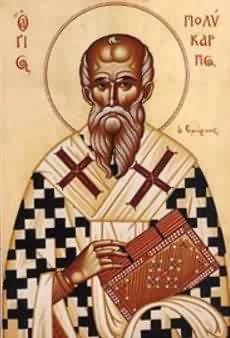
Polycarp is the Bishop of Smyrna that Ignatius wrote to and is also the disciple of the Apostle John. His close tie to the apostles is a testament to the Catholic faith which was passed down by the apostles. Sadly he says nothing about baptism either negatively or positively. Many inferences could be drawn concerning his pastoral letter/sermon to the Philippians but it is best to let the issue remain silent concerning Polycarp. He smoke neither positively or negatively against the issue of baptism, but it would be fair to suggest that Ignatius and Polycarp were in doctrinal communion concerning the close relationship between their churches.

Barnabas
This epistle is traditionally attributed to the travelling partner of St. Paul.  Instead it seems more appropriate to date this as a contemporary of Ignatius and Polycarp rather than the apostle to the gentiles. A conservative dating of his writing is the late first century to the early third century (80-140 AD).

In Chapter 11 of his epistle he contrasts figures of Israel with Baptism and the cross. Concerning baptism he writes

Let us further inquire whether the Lord took any care to foreshadow the water [of baptism] and the cross. Concerning the water, indeed, it is written, in reference to the Israelites, that they should not receive that baptism which leads to the remission of sins, but should procure another for themselves.
Epistle of Barnabas, Chapter 11

He says that the baptism Israel received was different than the baptism which we receive as Christians. Ours leads to the remission of sins, whereas the water of theirs is different. Barnabas continues to extol the conversion that occurs in baptism. Interestingly he is addressing adults who believe, and as Christians we could confess that faith alone does save, as such these men most certainly are saved. Nevertheless, in accordance with what the Scriptures say, Barnabas still extolls that when they descend in the water, they rise forgiven. There is no language of profession of faith, or sign/symbol, but rather it is like Ananias speaking to St. Paul who already believes and yet says “Rise and be baptized and wash away your sins, calling on his name” (Acts 22:16 ESV). Barnabas says:

Mark how He has described at once both the water and the cross. For these words imply, Blessed are they who, placing their trust in the cross, have gone down into the water; for, says He, they shall receive their reward in due time: then He declares, I will recompense them. But now He says, Their leaves shall not fade. This means, that every word which proceeds out of your mouth in faith and love shall tend to bring conversion and hope to many. Again, another prophet says, And the land of Jacob shall be extolled above every land. Zephaniah 3:19 This means the vessel of His Spirit, which He shall glorify. Further, what says He? And there was a river flowing on the right, and from it arose beautiful trees; and whosoever shall eat of them shall live for ever. Ezekiel 47:12 This means, that we indeed descend into the water full of sins and defilement, but come up, bearing fruit in our heart, having the fear [of God] and trust in Jesus in our spirit. And whosoever shall eat of these shall live for ever, This means: Whosoever, He declares, shall hear you speaking, and believe, shall live for ever.
Epistle of Barnabas, Chapter 11

Barnabas says “we indeed descend into the water full of sins and defilement, but come up, bearing fruit in our heart, having the fear [of God] and trust in Jesus in our spirit.” This is something that Lutherans would call a clear description of what Baptism does, it works faith, the forgiveness of sins, and salvation by the Word of God with Water.

Epistle to Diognetus
This epistle unfortunately speaks neither positively nor negatively to the sacrament of baptism.

Papias
Again there are no remaining works from Papias on Baptism. The fragments which we have do not speak to the Sacrament of Baptism.

Justin Martyr
Justin Martyr like the other fathers speaks to the efficacy of baptism quite explicitly in his Apology and in his Dialogue with Trypho. Concerning the Apology he says:

Then they are brought by us where there is water, and are regenerated in the same manner in which we were ourselves regenerated. For, in the name of God, the Father and Lord of the universe, and of our Saviour Jesus Christ, and of the Holy Spirit, they then receive the washing with water. For Christ also said, Unless you be born again, you shall not enter into the kingdom of heaven.
First Apology, Chapter 61

He specifically says that we are converted are regenerated by water (namely Baptism) and he speaks to the Word of God which accompanies this water, the Father, Son and Holy Spirit. Then he continues to cite the Gospel according to John where our Lord says “, Unless you be born again, you shall not enter into the kingdom of heaven.” Such birth from above comes by grace and the powerful working of God in Baptism.  
In his next writing, his dialogue with Trypho the Jew he says:

But there is no other [way] than this—to become acquainted with this Christ, to be washed in the fountain spoken of by Isaiah for the remission of sins; and for the rest, to live sinless lives.
Dialogue with Trypho, Chapter 44

Justin says there is no other way to be acquainted but by baptism. He is clearly advocating an apostolic and biblical understanding which as St. Peter would agree says … baptism now saves you.

Irenaeus
Irenaeus can rightly be known as the heresy basher. Despite his famous work Against Heresies, he doesn’t speak negatively to Baptism but rather supports the various views which can be known as the Catholic (universal) doctrine concerning Baptism. He is recorded saying:

"‘And [Naaman] dipped himself . . . seven times in the Jordan’ [2 Kgs. 5:14]. It was not for nothing that Naaman of old, when suffering from leprosy, was purified upon his being baptized, but [this served] as an indication to us. For as we are lepers in sin, we are made clean, by means of the sacred water and the invocation of the Lord, from our old transgressions, being spiritually regenerated as newborn babes, even as the Lord has declared: ‘Except a man be born again through water and the Spirit, he shall not enter into the kingdom of heaven’ [John 3:5]" (Fragment34 [A.D. 190]).

Irenaeus makes it abundantly clear that we are purified through baptism. We are made clean by “the sacrament water and the invocation of the Lord.” He says that we are spiritually regenerated. Like Justin Martyr he cites the gospel of John reminding that to be born from above / born again it is through water and spirit.

He also says

“Thus there are as many schemes of redemption as there are teachers of these mystical opinions. And when we come to refute them, we shall show in its fitting-place, that this class of men have been instigated by Satan to a denial of that baptism which is regeneration to God, and thus to a renunciation of the whole [Christian ] faith.” Against Heresies, I.21.1

In the first writing he contrasts the opinions of heretics with the orthodox. Concerning the latter he says that there are some "instigated by Satan to a denial of that baptism which is regeneration to God, and thus to a renunciation of the whole faith.”

What more can I say then what Irenaeus has already clearly stated in his writing Against Heretics?

I will try and write more later on, but for now this should suffice to say, as Irenaeus says, the Catholic faith teaches that baptism does save. 

10/13/13

On Baptism – Patrum Apostolicorum (Apostolic Fathers)

De Baptismo
 - The Adversaries - Part I
 - The Adversaries - Part II
 - The Apostolic Apostolic Fathers

This is my last post on the Apostolic Fathers which will consider the affirmative statements they made concerning baptism and infant baptism. The various statements show that the credobaptist arguments were never used, and while they did debate baptism, it was never whether it was efficient. There have been certain periods where a Tertullian-type view of baptism were prevalent, but they always understood that baptism saved and was for children as much as adults.

Polycarp
Polycarp is understood to be a disciple of the apostle John and he served as the bishop of Smyrna which was a church in Asia. This was also one of the seven churches mentioned by John in the Book of Revelation. According to The Martyrdom of Polycarp he is recorded as stating:
“Eighty and six years have I served Him, and He never did me any injury: how then can I blaspheme my King and my Saviour?”
While this is not a statement on baptism, he does indicate he has served Christ 86 years of his life. This would suggest Polycarp was baptized around 80 C.E. I am not trying to suggest that Polycarp is speaking explicitly to infant baptism, but rather if Polycarp is understood in light of the whole than it should be evident that it was likely speaking to a very early baptism.

Irenaeus
Irenaeus was born in Smyrna and was known to be a disciple of Polycarp (who was also a disciple of John). He was a bishop in modern day Lyon, which was part of Gaul. He died at the start of the third century. He was known for his writings against heresy. If infant baptism was a heresy he never spoke against it. Let's consider
“For He came to save all through means of Himself— all, I say, who through Him are born again to God — infants, and children, and boys, and youths, and old men. He therefore passed through every age, becoming an infant for infants, thus sanctifying infants; a child for children, thus sanctifying those who are of this age, being at the same time made to them an example of piety, righteousness, and submission; a youth for youths, becoming an example to youths, and thus sanctifying them for the Lord. So likewise He was an old man for old men, that He might be a perfect Master for all, not merely as respects the setting forth of the truth, but also as regards age, sanctifying at the same time the aged also, and becoming an example to them likewise.”
Against Heresies, 2.22.4
For the Church Fathers it is clear that baptism saves, and thus statements of saving should be understood in this context. He states "He came to save all through means of Himself— all, I say, who through Him are born again to God — infants, and children, and boys, and youths, and old men." Then goes on to say Christ comes for and sancties these different groups. I must repeat that for the Early Church salvation and baptism were inseparable, thus, it is proper to see this as a reference to baptism. This is further enforced by reference to the statement "born again to God ...sanctifying them ...". Let us continue.
“Thus there are as many schemes of redemption as there are teachers of these mystical opinions. And when we come to refute them, we shall show in its fitting-place, that this class of men have been instigated by Satan to a denial of that baptism which is regeneration to God, and thus to a renunciation of the whole [Christian]faith.” Against Heresies, I.21.1
"‘And [Naaman] dipped himself . . . seven times in the Jordan’ [2 Kgs. 5:14]. It was not for nothing that Naaman of old, when suffering from leprosy, was purified upon his being baptized, but [this served] as an indication to us. For as we are lepers in sin, we are made clean, by means of the sacred water and the invocation of the Lord, from our old transgressions, being spiritually regenerated as newborn babes, even as the Lord has declared: ‘Except a man be born again through water and the Spirit, he shall not enter into the kingdom of heaven’ [John 3:5]" (Fragment34 [A.D. 190]). 
It is important to consider these statements for they enforce the fact that the Early Church, or at least Irenaeus understand baptism and salvation to be an act of God, one and the same.

Ignatius
Ignatius was a headstrong bishop of Antioch who seemed almost excited as he traveled to Rome to be executed. He does not speak explicitly to infant baptism but he does speak to the efficiency of baptism. He states the following:
Let my spirit be counted as nothing for the sake of the cross, which is a stumbling-block (1 Corinthians 1:18) to those that do not believe, but to us salvation and life eternal. Where is the wise man? Where the disputer? (1 Corinthians 1:20) Where is the boasting of those who are styled prudent? For our God, Jesus Christ, was, according to the appointment of God, conceived in the womb by Mary, of the seed of David, but by the Holy Ghost. He was born and baptized, that by His passion He might purify the water.
The Epistle of Ignatius to the Ephesians, 18
“Let none of you be found a deserter. Let your baptism endure as your arms; your faith as your helmet; your love as your spear; your patience as a complete panoply. Let your works be the charge assigned to you, that you may receive a worthy recompense. Be long-suffering, therefore, with one another, in meekness, as God is towards you. May I have joy of you for ever!”
The Epistle of Ignatius to Polycarp, Chapter 6
“…baptism, which is administered that we should have fellowship with the death of the Lord.”
Epistle to the Philippians, Chapter 1
Igantius' view of baptism is consistent with the other Early Church Fathers. This should be remembered since it affirms the universality (catholicity) of the doctrine of baptism.

Shepherd of Hermas
The Shepherd is another father who does not speak to infant baptism, but does say some powerful things about baptism. He writes:
And I said to him, I should like to continue my questions. Speak on, said he. And I said, I heard, sir, some teachers maintain that there is no other repentance than that which takes place, when we descended into the water and received remission of our former sins. He said to me, That was sound doctrine which you heard; for that is really the case. For he who has received remission of his sins ought not to sin any more, but to live in purity.
Sheperd of Hermas, Book 2. CH III
“Explain to me a little further, sir, I said. What is it that you desire? he asked. Why, sir, I said, did these stones ascend out of the pit, and be applied to the building of the tower, after having borne these spirits? They were obliged, he answered, to ascend through water in order that they might be made alive; for, unless they laid aside the deadness of their life, they could not in any other way enter into the kingdom of God. Accordingly, those also who fell asleep received the seal of the Son of God. For, he continued, before a man bears the name of the Son of God he is dead; but when he receives the seal he lays aside his deadness, and obtains life. The seal, then, is the water: they descend into the water dead, and they arise alive. And to them, accordingly, was this seal preached, and they made use of it that they might enter into the kingdom of God.”
Shepherd of Hermas, Book III.Chapter 16
Origen
Origen was born to Christian parents around 185 (near Alexandria, Egypt). He does speak explictly to the doctrine of infant baptism. Now there are some Baptists who may like to point out that centuries after Origen's death he was condemned a heretic, and this is true, but they must remember their (misplaced) hero Tertullian was also condemned a heretic. Their failings do not take away from the apostolic teachings concerning baptism. Origen writes:
I take this occasion to discuss something which our brothers often inquire about. Infants are baptized for the remission of sins. Of what kinds? Or when did they sin? But since "No one is exempt from stain," one removes the stain by the mystery of baptism. For this reason infants are baptized. For "Unless one is born of water and the Spirit he cannot enter the kingdom of heaven."
Homily on Luke 14:5
In his Commentaries on Romans, 5:9, he argues that this “usage” came from the apostles. “The Church received from the apostles the tradition of giving baptism even to infants.” In context:
The Church received from the apostles the tradition of giving baptism even to infants. The apostles, to whom were committed the secrets of the divine sacraments, knew there are in everyone innate strains of [original] sin, which must be washed away through water and the Spirit"
Commentaries on Romans 5:9
He says in his Homily on Leviticus, 8.3, “In the Church, baptism is given for the remission of sins, and, according to the usage of the Church, baptism is given even to infants.” In context:
"Every soul that is born into flesh is soiled by the filth of wickedness and sin. . . . In the Church, baptism is given for the remission of sins, and, according to the usage of the Church, baptism is given even to infants. If there were nothing in infants which required the remission of sins and nothing in them pertinent to forgiveness, the grace of baptism would seem superfluous"
Homilies on Leviticus 8:3
If what Origen says is true then the doctrine of infant baptism and baptismal regeneration are apostolic in origen [sic] (... I mean origin). While the previous fathers do not explicitly speak to infant baptism, they all unanimously speak to baptismal regeneration. Infant baptism necessarily follows out of the teaching if baptismal regeneration.

Apostolic Tradition (Hippolytus of Rome)
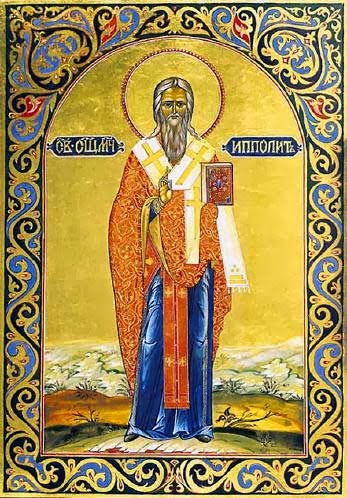
The Apostolic Tradition has been tentatively dated to around 215. This anonymous work is believed to have been written by Hippolytus of Rome. It is a very early writing. In chapter 21.4, Hippolytus teaches:
“The children shall be baptized first. All of the children who can answer for themselves, let them answer. If there are any children who cannot answer for themselves, let their parents answer for them, or someone else from their family.”
Apostolic Tradition, 21.4
 Yet again we see a clear teaching that children do receive the gifts of baptism. This gift is also a washing of regeneration for children as well as adults.

Cyprian
Cyprian was born in 200 AD and died in 258, this places his writings in the same timeframe as the other fathers. Interestingly, he was a disciple of Tertullian in Carthage. Tertullian was adament that baptism be delayed for the safeguard of the children, but in the era of Cyprian they returned to the apostolic doctrine and were debating whether to follow the tradition of the Jews or to baptize children right away. Cyprian is speaking on behalf of his presbytery and writes:
"As to what pertains to the case of infants: You [Fidus] said that they ought not to be baptized within the second or third day after their birth, that the old law of circumcision must be taken into consideration, and that you did not think that one should be baptized and sanctified within the eighth day after his birth. In our council it seemed to us far otherwise. No one agreed to the course which you thought should be taken. Rather, we all judge that the mercy and grace of God ought to be denied to no man born"
Letters 64:2 [A.D. 253]
He does not believe that baptism should be delayed until the eighth day, but should be administered immediately.
"If, in the case of the worst sinners and those who formerly sinned much against God, when afterwards they believe, the remission of their sins is granted and no one is held back from baptism and grace, how much more, then, should an infant not be held back, who, having but recently been born, has done no sin, except that, born of the flesh according to Adam, he has contracted the contagion of that old death from his first being born. For this very reason does he [an infant] approach more easily to receive the remission of sins: because the sins forgiven him are not his own but those of another"
ibid., 64:5
It is interesting that his opposition Fidus does not argue like Tertullian but instead appeals to the tradition of the Jews that baptism (like circumcision) be adminsitered on the eigth day. There is a clear parallel between circumcision and baptism. Cyprian is not speaking on behalf but of an entire group of priests at this local council in North Africa. When Cyprian's teacher Tertullian argued for delayed baptism he did so in the context of an already well-established practice. Hence, infant baptism was a part of North Africa for quite some time.

Conclusions
What conclusions can be reached by the statements of the Early Chuch Fathers? Two very strong conclusions must be accepted. The first is without question: the Early Church Fathers unanimously understand baptism to be a saving act of God. This is without question according to the wealth of writings we have from the fathers. The second is that arguably infant baptism is indeed the practice of the apostles which was passed down. This can be inferred by two strong points. The first is that the Church Fathers understood baptism to be something that was administered for the remission of sins. In other words it was a saving act for sinners. Unless someone is willing to argue in favour of Pelagius that children are not sinners, then it seems proper to give them the monergistic and gracious means of grace.

The next powerful point is that in and around 100 to 150 years after the death of the apostles there is testimony from Asia Minor (Smyrna), France (Gaul), Egypt (Carthage), and Rome that explictly speaks to infant baptism as a practice of the apostles. There is such a wide berth between these testimonies that if infant baptism was a heresy, it was the greatest heresy to ever befall the Christian Church. All Christians understood baptism to be a saving act and within 100 years from Egypt to Asia Minor to Rome and as far as France the Christian Church was already influenced with no recorded opposition. Secondly, despite the fact the Church was always on the offensive to fight the various heresies that emerged there was absolutely zero opposition to infant baptism. Infant baptism was only seriously questioned by the Anabaptists, and prior to this it was nearly universally practiced and confessed.

I must consider Christ's words to St. Peter: "And I say also unto thee, That thou art Peter, and upon this rock I will build my church; and the gates of hell shall not prevail against it."

Christ most certainly did not leave her bride in darkness for 1500 years.

10/12/13

On Baptism – The Adversaries - Part II

De Baptismo
 - The Adversaries - Part I
 - The Adversaries - Part II
 - The Apostolic Apostolic Fathers

Wow. I have been quite busy this past month, but I thought I would take some time tonight meditating on the topic of baptism.

My first post was titled On Baptism: The Adverseries. The purpose was to address the alleged adverseries which opposed the apostolic doctrine of infant baptism. The post considers the opinions of Tertullian who according to many Baptists is the most out-spoken 'credo-baptist' of his era, but if one takes the time to thoroughly read Tertullian in the context of his writings it becomes apparent he did not adhere to a credo or anabaptist view of baptism, but rather a modified and pragmatic view of the sacrament in light of and in fear of apostasy.

The following post will continue where we left on and address the teachings of Justin Martyr. He is often cited by Baptists in favour of their teaching. The truth is that his letters need to be understood in the context of his vocation which was an evangelist/apologist. As such he was neither a pastor nor a bishop and his concern was not shepherding a flock but engaging the Pagan religions/philosophies of the Greco-Roman world. The reason this is important is because as an apologist he is addressing those outside the faith, while pastors address the faithful and their families. When you finish reading it should be clear in the context of what Justin taught baptism does and his vocation that he also adhered to an apostolic view of baptism, namely, that it saves and is for children as well as adults.

Justin Martyr
“And many, both men and women, who have been Christ's disciples from childhood, remain pure at the age of sixty or seventy years; and I boast that I could produce such from every race of men.” First Apology, Chapter 15.
This is not a description of baptism but it does state that many have been disciples from childhood.
“And for this [rite] we have learned from the apostles this reason. Since at our birth we were born without our own knowledge or choice, by our parents coming together, and were brought up in bad habits and wicked training; in order that we may not remain the children of necessity and of ignorance, but may become the children of choice and knowledge, and may obtain in the water the remission of sins formerly committed, there is pronounced over him who chooses to be born again, and has repented of his sins, the name of God the Father and Lord of the universe; he who leads to the laver the person that is to be washed calling him by this name alone. For no one can utter the name of the ineffable God; and if any one dare to say that there is a name, he raves with a hopeless madness. And this washing is called illumination, because they who learn these things are illuminated in their understandings. And in the name of Jesus Christ, who was crucified under Pontius Pilate, and in the name of the Holy Ghost, who through the prophets foretold all things about Jesus, he who is illuminated is washed.”
First Apology, Chapter 61

Justin here teaches that we "obtain in the water the remission of sins formerly committed." Without a doubt Justin does continue that "him who chooses to be born again, and has repented of his sins, the name of God the Father and Lord of the universe." Certainly this speak to the those who as converts have repented and believed before their baptism, but it also speaks to the efficiency of baptism which is very important.
Then they are brought by us where there is water, and are regenerated in the same manner in which we were ourselves regenerated. For, in the name of God, the Father and Lord of the universe, and of our Saviour Jesus Christ, and of the Holy Spirit, they then receive the washing with water. For Christ also said, Unless you be born again, you shall not enter into the kingdom of heaven. 
First Apology, Chapter 61

Again in this chapter he writes,
He repeats that the converts "are regenerated in the same manner" which is baptism, he then proceeds to quote John 3:3.
But there is no other [way] than this—to become acquainted with this Christ, to be washed in the fountain spoken of by Isaiah for the remission of sins; and for the rest, to live sinless lives.
Dialogue with Trypho, Chapter 44
Yet again we see that in baptism we receive the remission of sins according to Justin. It should be sufficiently clear that Justin teaches in accordance with the apostolic doctrine of baptismal regeneration. Or as St. Peter states "Baptism now saves you." 

I will continue tomorrow with the other Apostolic Fathers. 

9/5/13

On Baptism – On Baptism: The Adversaries

De Baptismo
 - The Adversaries - Part I
 - The Adversaries - Part II
 - The Apostolic Apostolic Fathers

The title of this post is taken from one of Tertullian’s works ‘On Baptism’ and while the context would seem to indicate that he is an adversary, it is quite contrary to the debate in question. The necessity of engaging Tertullian is because he is the greatest voice for delaying baptism of infants. The problem is that while many Baptists will attempt to herald Tertullian as one of their own,  they never take into account the whole of his theology which was rooted in an apostolic, catholic and scriptural understanding of baptism, albeit slightly jaded regarding where baptism is applied. Another troubling issue in appealing to Tertullian is that in his later years he became a Montanist, and some Baptists will refer to these as the ‘true’ Christians who stood against the devilry of the Roman Catholic Church. I will not be addressing the claims made by any of these people, or addressing the issue of Tertullian and Montanism, but rather will briefly consider some statements he made concerning baptism both its efficacy and its usage.

Tertullian was born in or around Carthage around 145 or 155 A.D. to pagan parents. Some scholars of the early 20th century scholars suggested that Tertullian was a lawyer (A. Harnack, a liberal Lutheran theologian). The suggestion that Tertullian was a lawyer is not completely far-fetched. His writings have the rhetoric and consistency of one who has had formal training. Nevertheless, he converted to Christianity around 185 A.D. He served in Carthage in the last part of the 2nd century, but there is no evidence that I am aware of that suggests he was ever a bishop. He is also the first theologian credited with the use of the word trinitas or Trinity.

Concerning Baptism
What exactly does Tertullian suggest concerning baptism? It may be helpful to look at the first paragraph of his work On Baptism:
Happy is our sacrament of water, in that, by washing away the sins of our early blindness, we are set free and admitted into eternal life! ... But we, little fishes, after the example of our ΙΧΘΥΣ Jesus Christ, are born in water, nor have we safety in any other way than by permanently abiding in water; so that most monstrous creature, who had no right to teach even sound doctrine, knew full well how to kill the little fishes, by taking them away from the water!(Tertullian, De Baptismo, ch.1)
He clearly expresses that we “are born in water” and that we have our safety “by abiding in water.” It reminds me of what Martin Luther said “Remember your baptism.” It is not that we were baptized in a past sense, but we ‘are’ presently baptized.  As the chapters proceed Tertullian reminds the reader by using various types, shadows and examples found in the Scriptures which point to the waters of baptism. The first opposition that Tertullian addresses are those who would blasphemously refuse baptism altogether, and would instead rather trust in their own faith. As Lutherans we look to our baptism as extra nos (outside ourselves) rather than an inward searching for a pure faith, or an inward searching for pure works. Tertullian responds as follows:
And so they say, Baptism is not necessary for them to whom faith is sufficient; for withal, Abraham pleased God by a sacrament of no water, but of faith. But in all cases it is the later things which have a conclusive force, and the subsequent which prevail over the antecedent. Grant that, in days gone by, there was salvation by means of bare faith, before the passion and resurrection of the Lord. But now that faith has been enlarged, and has become a faith which believes in His nativity, passion, and resurrection, there has been an amplification added to the sacrament, viz., the sealing act of baptism; the clothing, in some sense, of the faith which before was bare, and which cannot exist now without its proper law. For the law of baptizing has been imposed, and the formula prescribed: Go, He says, teach the nations, baptizing them into the name of the Father, and of the Son, and of the Holy Spirit. The comparison with this law of that definition, Unless a man have been reborn of water and Spirit, he shall not enter into the kingdom of the heavens, has tied faith to the necessity of baptism.” (Tertullian, De Baptismo, ch.13)
Tertullian makes it clear that before Christ, there was a salvation “of bare faith,” but this was “before the passion and resurrection of the Lord.” Now our faith trusts in a God found in the nativity, passion, and resurrection. As such what has been added to faith is “the sealing act of baptism; the closing, in some sense, of the faith which was before bare.” After reminding the reader of the baptismal formula and institution by Christ he writes“Unless a man have been reborn of water and Spirit, he shall not enter into the kingdom of the heavens, has tied faith to the necessity of baptism.”

For Tertullian the issue of baptism is of necessity and efficacy for the believer and the faithful. He does not render faith void, but rather shows that in baptism the bare faith is clothed in the death and resurrection of Christ. In another work, he says, “Whence it follows that they who have by faith attained to the resurrection, are with the Lord after they have once put Him on in their baptism.” (Tertullian, De Anima, ch.19) A few chapters later he proceeds to say: “that we were once dead, alienated, and enemies to the Lord in our minds, while we were living in wicked works; that we were then buried with Christ in baptism, and also raised again with Him through the faith of the operation of God, who has raised Him from the dead.” (Tertullian, De Anima, ch.23) Tertullian like the other Church Fathers advocated that baptism is a method of receiving God’s grace and salvation. This is very essential for understanding Tertullian’s view of the usage of baptism.

Concerning Infants
Now the daunting question is what did Tertullian say concerning children?
The Lord does indeed say, Forbid them not to come unto me. Let them come, then, while they are growing up; let them come while they are learning, while they are learning whither to come; let them become Christians when they have become able to know Christ. Why does the innocent period of life hasten to the remission of sins? More caution will be exercised in worldly matters: so that one who is not trusted with earthly substance is trusted with divine! Let them know how to ask for salvation, that you may seem (at least) to have given to him that asks. (Tertullian, De Baptismo, ch.18)
A naïve and uncritical reading of this text may simply dismiss infant baptism, but anyone who seriously considers the words of Tertullian will recognize several things. First, Tertullian is addressing an issue of infant baptism because it is already present and well established in North Africa. Second, he is addressing arguments which in turn take the words of Christ as a defense. Lastly, his argument is stemmed from an issue of fear and pragmatism. 

Tertullian's pragmatism was out of fear the baptized would fall from grace. Tertullian says “Why does the innocent period of life hasten to the remission of sins? More caution will be exercised in worldly matters: so that one who is not trusted with earthly substance is trusted with divine!” For many of the early church fathers there was a fear that serious sin after baptism would lead to the condemnation of the Christian, and Tertullian was addressing a serious concern of piety and salvation. He wanted to forgo the baptism of infants until they were so grounded that they would not fall from the faith.

Tertullian nowhere defends his position from the Scripture or tradition, but he instead responds to a well-grounded practice in Carthage. Before Tertullian responds to the argument (above) about the Lord not forbidding he says the following:
And so, according to the circumstances and disposition, and even age, of each individual, the delay of baptism is preferable; principally, however, in the case of little children. For why is it necessary— if (baptism itself) is not so necessary — that the sponsors likewise should be thrust into danger? Who both themselves, by reason of mortality, may fail to fulfil their promises, and may be disappointed by the development of an evil disposition, in those for whom they stood? (Tertullian, De Baptismo, ch.18)
I repeat, Tertullian does not appeal to the rule of faith, traditions of the apostles, or Holy Scripture, but instead, appeals to his own opinion that “the delay of baptism is preferable.” Why? If the parents were unfit or unavailable to raise the children it is advisable to forgo baptism.  He does say “For why is it necessary— if (baptism itself) is not so necessary…” If the reader takes into account not only the rest of this work, Tertullian’s theology, and the understanding of other Christians of the day, it seems apparent that he is suggesting that if the baptism is not necessary (namely the child is not in peril of infant death), then it is preferable to wait.

Tertullian even goes further and suggests that not only infants, but the unmarried should hold off baptism because of their lusts. He says
For no less cause must the unwedded also be deferred— in whom the ground of temptation is prepared, alike in such as never were wedded by means of their maturity, and in the widowed by means of their freedom— until they either marry, or else be more fully strengthened for continence. If any understand the weighty import of baptism, they will fear its reception more than its delay: sound faith is secure of salvation. (Tertullian, De Baptismo, ch.18)

Is this really the Tertullian that Baptists want to claim as their own? Tertullian says that baptism is necessary for salvation, he says that it is only preferable to delay baptism if it isn’t necessary (emergency baptism), he recognizes that infant baptism was present in at least North Africa, and even goes on to suggest that unmarried individuals should not be baptized. After being raised a Baptist, I can honestly say this does not sound like any of the pastors that I had listened to or read. In fact, Tertullian is not the voice of an adversary, but the voice of a pragmatist and he only helps to secure the position that the Fathers most certainly taught infant baptism.

It should be apparent that the reason I chose Tertullian first was to show how the alleged opponent of infant baptism and victor for some Baptists, is really only a misguided pragmatist who helps to support the issue of infant baptism. We will be returning to Carthage in the next post when we consider how things changed when Tertullian's disciple Cyprian was bishop of Carthage.

Note: All citations were taken from the translations available at www.newadvent.com.

9/4/13

Another Lutheran inclined to rant ...

It seems appropriate to introduce myself before I begin. I share a similar path as Andrew, namely, formerly Reformed, and presently Lutheran. I was blessed throughout my life, even during periods where I did not profess the purity of doctrine that we confess as Lutherans. Nevertheless, I always was missing the substance and clarity of God's Word uninhibited by some of the false teaching I had believed. One of the first doctrines that has motivated by decision to investigate the Reformed and Lutheran traditions was baptism. I was raised a Baptist with Calvinistic leanings and eventually was admitted as a Presbyterian in the ARP. However, the inconsistencies and divisive nature of the Reformed faith led me to question what they confess of baptism and as a result I was blessed to read some of Luther's writings on baptism (Small Catechism and Large Catechism). Eventually I studied the Lords Supper and the beauty of receiving Christ's Body and Blood were enough to sustain me. 

It is for this reason that my first blog post(s) will introduce the topic of Baptism in lieu of the Early Church Fathers. One of the reasons for discussing this topic is because many Baptists will assert that infant baptism is a result of Roman Catholicism, Emperor Constantine, or some other extra-biblical and heretical means. Next to this is the adversity of Baptists and Reformed to the biblical doctrine of baptism, namely, that it saves us. For this reason, the discussion will have a two-fold purpose. In general, to understand what it is the Church confessed of baptism, and its efficacy, and in particular to see how infant baptism was a doctrine taught by the apostles and delivered down through the ages. The posts will conclude by showing that at the end of the Second Century and beginning of the Third Century the practice of infant baptism was normative for the Christian Church. The consistency and purity of this doctrine will help to enforce its orthodoxy. The unopposed nature of its teaching also helps to show the Catholicity of the teaching. Infant Baptism was practiced in Asia Minor, France, Egypt, Carthage, and Rome by the mid-Third Century. 

I am going to address the issue of Baptism over at least three blog posts. The first post will very briefly discuss the alleged opposition to baptism asserted by the Apostolic Fathers Justin Martyr and Tertullian. This will be followed by a more detailed discussion of baptism, its efficacy and the orthodoxy of infant baptism across the Christian Church. In order to drive the point home, the following Early Church Fathers will be considered: Polycarp, Ignatius, Shepherd of Hermas, Irenaeus, Origen, Hippolytus, and Cyprian. Since most Baptists assert that baptism was a development of the Fourth Century, the last post will briefly address the Augustine-Pelagian Debate regarding Original Sin. One of the reasons for discussing this topic is because of its relationship to baptism's efficacy and the necessity of baptism for all sinners. 


I look forward to hopefully posting more with Andrew, but for the time being I will try and dedicate some time to this short little series. I am quite busy with some upcoming exams and will do my best to keep up on these posts.